
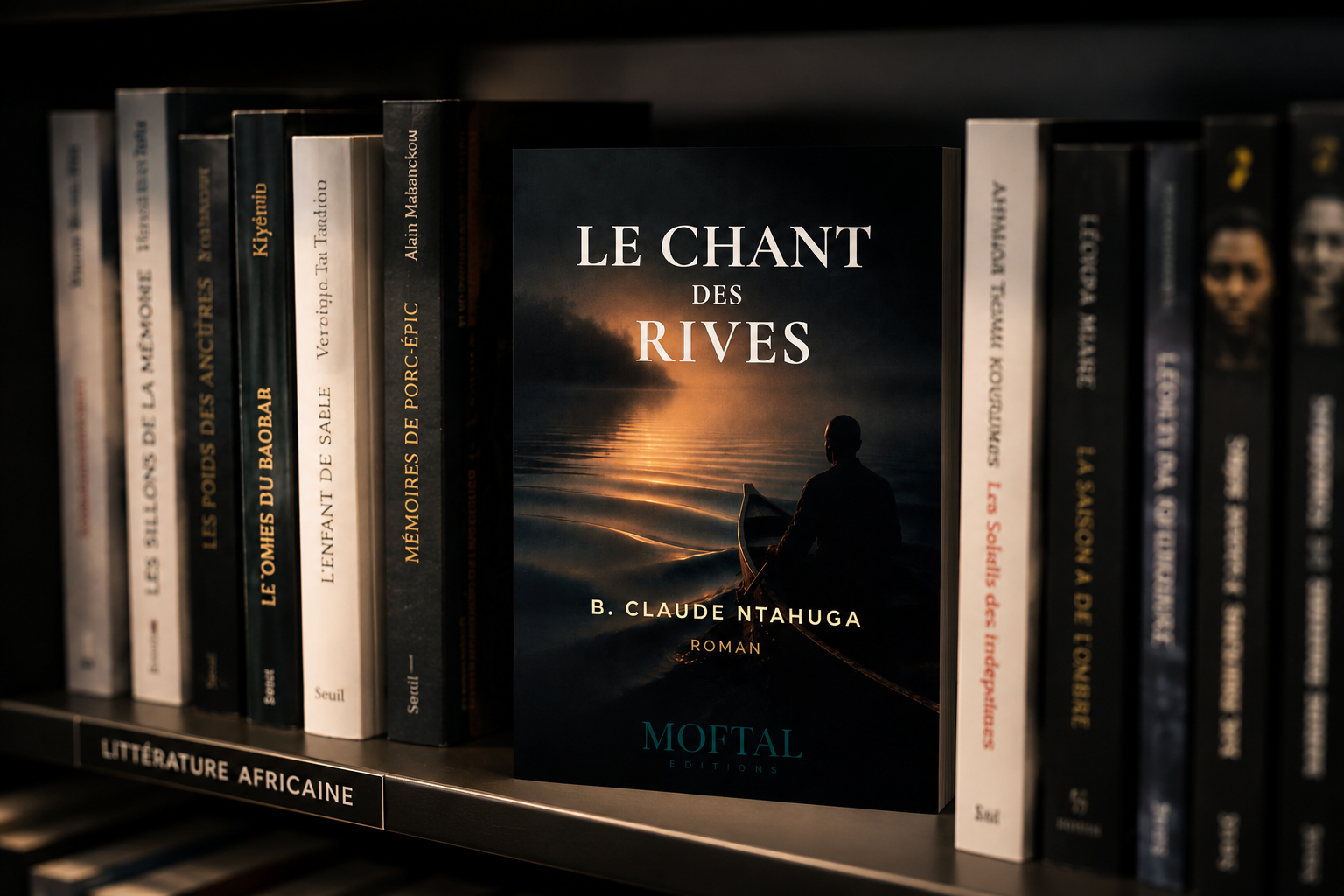
There is a question I have been asked ever since I announced this novel, sometimes kindly, sometimes with a barely veiled reproach: “But Claude — you who have been writing all your life, who have lent your pen to so many, why so late?” I shall try to answer honestly. It will be long. It may be uncomfortable. But it is the only answer I know how to give.
The vocation of the ghost
Let us begin at the beginning — or rather with the enigma. Since the age of fifteen I have been writing for others. Not for myself. For others.
It started, like many things in my life, in a courtyard of the Lycée de Mukenke. My schoolmates had discovered that I could do something they could not: turn an emotion into words. Not just any words — the right ones, the ones that touch, the ones that make the girl in front of you raise her eyes from the page and look at you differently. They would come to find me, shy, slightly ashamed, with their crumpled notes in their pockets. “Claude, write me something for Vestine.” “Claude, can you help me for Clarisse?” I would take their feelings — often confused, often clumsy, always sincere — and put them in order. I gave them a form that their author could never have given them alone.
I was what is called in French, with a word that carries its full historical charge, a “nègre” — a ghostwriter. The one who writes in the shadow so that others may shine in the light. Except that I was fifteen, and my employers paid me in doughnuts and in protection on the playground.
Since the age of fifteen I have been writing for others. The question is: why did I take so long to write for myself?
This vocation of the ghost never left me. It simply changed scale. Love notes became political speeches. Adolescent emotions became ministerial positions. The ink of the playground turned into the ink of cabinets, conference rooms and film studios.
For more than twenty years I put my pen at the service of causes, institutions, persons. I wrote speeches for figures who wanted to say something true but could not find the words. I drafted reports, designed projects for organisations that wanted to convince but did not know how to build an argument. I signed, for a First Lady of Burundi and a former Congolese minister, a whole book — because writing for someone else is sometimes gathering their silences and tending to their wounds. I made documentaries that others presented under their own name before hundreds of guests in Belgium, in Burundi or in France.
I was the ghost. The faceless voice. The architect of words who dismantled his scaffolding before the visitors arrived.
And all that time, my own book waited, in a trunk twice-locked, at the bottom of my memory.
The paradox of the one who gives a voice
There is something deeply paradoxical in this craft of lending one’s pen. One is, by definition, the one who knows how to put things into words. The one whom others need to say what they feel. And yet, that very competence becomes a reason not to listen to oneself.
Here is how it works: when you spend your days deciphering the emotions of others to make them legible, when you are constantly in listening, in empathy, in service — you end up developing a strange deafness to your own inner voice. You become so accustomed to ignoring the “I” in order to highlight the “he” or the “you” that the “I” ends up making itself very small, sitting in a corner and patiently waiting for you to deign to grant it a little attention.
I recently read something Marie-Louise Sibazuri wrote me after reading my manuscript, and it stopped me cold. She said: “You had told me you wanted to share the story of your life. I thought those were empty words. So many people tell me they will soon write a book, and twenty years later, they still have not done it.”
Twenty years. She was right. I had begun to “want to write this book” somewhere in the mid-2000s. Perhaps earlier. And for twenty years that intention had remained an intention — a seed that did not germinate, not for lack of soil, but for lack of water. For lack of an act of courage I could not bring myself to perform.
« So many people tell me they will soon write a book, and twenty years later, they still have not done it. »
— Marie-Louise Sibazuri, Note on the manuscript
But the real question is not why I was late. The real question is: what was that delay good for?
The respectable reasons
Let me start with the respectable reasons — the ones one can say in company without blushing.
The first is time. When you are an international cooperation consultant, when you manage projects in Africa in contexts of crisis or reconstruction, when you are political secretary of a party, when you run from one country to another like a carrier pigeon between Bamako and Brussels, between Kampala and Johannesburg — you do not sit serenely in front of a blank page to dig into your own memory. You are in the permanent emergency of the other, of the project, of the meeting, of the report due, of the flight to catch.
I remember those years as a perpetual motion. Mali, Niger, Switzerland, DRC, Rwanda, Togo, Uganda, Ghana, Chad, South Africa, Canada — twenty-five countries, hundreds of flights, thousands of meetings. The kind of life where weeks resemble short stories — intense, dense, complete in themselves — but where the novel requires something else: a continuity, a suspension of the present, a decision to stay put long enough to dig.
The second respectable reason is politics. From 2008 to 2013 I was a private consultant to the President of Burundi. For those five years I was at the heart of power — not beside it, at the heart. And when you are at the heart of power, you cannot write freely. Not about yourself. Not about your family. Not about 1993. Too many people you still know, too many files still open, too many possible interpretations, too many collateral risks.
In 2009, Iwacu had named me among the 50 figures advancing Burundi. I took that seriously. I did not want my personal book to be read as a political manifesto, a position in one camp, a co-optation. I wanted to wait until I had enough perspective for the work to be greater than the circumstances.
When you are in the permanent emergency of the other, you end up confusing service to others with desertion of yourself.
The third respectable reason is the fear of parasitisation. The story of my family — a Tutsi father, a Hutu mother, the 1993 violence — is a story that others have told before me, from the outside, with their categories, their imported reading grids, their sometimes clumsy good intentions. I did not want to publish a book that would be immediately read through the prism of the Burundian ethnic conflict, reduced to a “testimony”, filed in the “reconciliation literature” drawer before the first page had even been read.
I wanted a book that would overflow its circumstances. A universal book, or at least one that would have that ambition. That takes time. That takes maturation. The green wine is not ready, even when you are thirsty.
The less respectable reasons
Now, the less respectable reasons. The ones you keep for sleepless nights.
The first is the fear of betraying. My story is not only mine. It belongs to the living. To my mother. To my father. To my brothers and sisters. To friends who did not have the luck to go into exile and who lived from the inside the years I am merely recounting. To put on paper what I saw, felt, understood — is also to put on paper what they lived, without asking their permission, sometimes against their chosen silence.
In Burundian culture, one does not speak of certain things. One protects the family by keeping silent. One honours the dead by not stirring certain muds. Silence is not denial — it is a form of respect, a way of letting wounds heal without reopening them in every conversation. To write this novel was to take a unilateral decision: to decide that healing went through words and not through silence. To decide that for myself, but also, in a way, for my own.
It took me a long time to find a way of doing it without betraying. Without exposing those who did not want to be exposed. Without instrumentalising the dead. Without reducing the living to characters in my novel. The autobiographical novel, by definition, is an act of gentle violence towards those one loves — even when it is an act of love.
« To write is to build a bridge. A bridge between the living and the departed, between past generations and those to come, between those who have suffered and those who must understand. »
— B. Claude Ntahuga, Author’s note, 2026
The second less respectable reason is impostor syndrome. Yes. Me too.
For years, I wrote speeches for people more powerful than me. I drafted books under the signature of people whose name carried more weight than mine. I put my words in the mouths of others, and somewhere along the way, I had come to believe that my words had value only in the mouths of others. That my voice, alone, without the credit of a title or a position or a more famous name, did not deserve to occupy the space of a book.
It is insidious, that thought. It does not say “you are not good”. It says something more subtle and more devastating: “Who are you to tell this? Who asked you? Who is waiting for you?”
The answer I should have given myself long ago — that I finally managed to give myself — is: me. I asked myself for it. I was waiting for myself. Twenty years I had been waiting.
Who asked you? Who is waiting for you? — Me. I had asked myself. Twenty years I had been waiting for myself.
The third reason, the deepest, the hardest to formulate: I was afraid of what I would find in the trunk.
In my author’s note to the publisher, I wrote: “By deciding to write The Song of the Shores, I consented to enter a trunk buried deep in my memory, a travelling chest sealed by decades of silence.” This is not a comfortable metaphor. It is a precise description of a real psychological state.
To open that trunk was to accept finding oneself face to face with things one had carefully avoided for twenty years. The images of 1993. The faces of those who are no longer there. The mute pains one inherits from parents who could never name them. The question of identity that shatters — not the philosophical, abstract question of academic conferences — the real one, the one of the Bujumbura schoolyard when a classmate asks you: “So you, what are you?” and you search for an answer for thirty years.
One postpones that opening. One says “tomorrow”. One says “when I have time”. One says “when the children are grown”. One tells oneself stories to avoid sitting opposite oneself in the dark and looking at what is there.
What had been preparing me without my knowing
But here is something I understood while writing: those twenty years were not lost time. It was cooking time.
Every time I had lent my pen to someone else, I was learning something about writing — about how a voice is built, how a narration holds, how an emotion is transmitted without getting lost in the transmission. Every speech written for another was a style exercise that I did not yet know I was doing for myself. Every documentary co-directed taught me the editing of the real — how to choose sequences, how to make disparate fragments hold together into something meaningful.
The book I wrote for the First Lady taught me something essential: how to hold a voice that is not mine for 200 pages, how to remain faithful to someone while helping them be more fully themselves on the page. It is exactly the opposite problem to that of the autobiographical novel — and it is also exactly the same problem, just inverted.
Pour mieux s’entendre taught me Burundi from above — the gaze of the camera, the distance necessary to see what is no longer seen from inside. That documentary remove I needed in order to write the childhood of Bwiza. To look at plot 94 on the Première Avenue with both the closeness of someone who lived there and the lucidity of someone who came back.
And the Iwacu articles — those political columns on the Burundi-Rwanda tensions that earned me insults and threats in 2025 — taught me the hardest thing: writing under one’s own name on dangerous subjects. Owning one’s words. Not hiding behind anonymity, fiction or another person’s pen. Writing and signing, even when it costs something.
Those twenty years were not lost time. It was cooking time. I understood that when I finally opened the trunk.
The moment when the trunk opened
There was not a single moment. There were several, like as many blows struck on a rusted lock before it gave way.
The first blow was a conversation with Marie-Louise Sibazuri, a few years ago. She looked me in the eye and said: “Claude, you have told me this ten times in ten years. Are you going to do it or not?” There was no malice in her voice — only that benevolent frankness she reserves for people she loves enough not to lie to. I realised I had been lying to myself for a long time. That “I want to write this book” had become a social formula, a way of presenting myself as someone interesting without ever taking the risk of really being so.
The second blow was an evening in Brussels, alone in my flat, looking through childhood photos of Bujumbura. That photo of the Ngagara plot. Those faces all changed, or gone. That courtyard where I played thousands of hours and which today must be unrecognisable. And the thought that crossed me, sudden and cold as water: if I do not write this now, it will die with me. Nobody else can write this. No one has lived exactly what I lived, seen exactly what I saw, been exactly that child in that courtyard in 1993. If I do not do it, it disappears.
It is a simple thought, almost banal. But it was revealed to me as an evidence I should have had twenty years earlier: my voice is not interchangeable. It cannot be replaced by the voice of someone else, even well-intentioned, even African, even Burundian. There is a point of view — mine, precisely mine, born of that childhood precisely, of that father and that mother precisely, of that double belonging precisely — that no one else can occupy.
The third blow was the pandemic. The lockdown. The forced halt of perpetual motion. Suddenly I could no longer leave. I could no longer flee into action, into the next project, into the next flight. I was there, in my Brussels flat, with myself, with time, with the twice-locked trunk at the bottom of my memory.
I opened the trunk.
« By deciding to write The Song of the Shores, I consented to enter a trunk buried deep in my memory, a travelling chest sealed by decades of silence. I found there fragments of childhood: bursts of laughter cut short too soon, the aroma of my grandmother’s coffee, the red dust that clung to our sandals and our dreams. »
— B. Claude Ntahuga, Author’s note, 2026
What I found in the trunk was not what I feared. Not only ghosts, not only pains. There were also living, luminous things, intact splinters of joy, faces preserved in their full presence, moments of absolute brotherhood that the violence had not been able to reach because they had come before. The games in the courtyard of the plot. The aroma of the coffee my grandmother prepared at early morning. The delicious rivalries of a blended sibling group of more than a dozen children. The complicit glances exchanged in Kirundi in a city that spoke too many languages at once to be frankly sad.
I had feared a cemetery. I found an inhabited house.
What I learned by becoming my own ghostwriter
There is an irony I savour, now that the novel is written. For twenty years, I was the ghostwriter of others. I put my words in voices that were not mine, I inhabited skins I had then to abandon to their rightful owners. And when I finally wrote this book — the book of which I was the sole possible owner — I realised I was still working in exactly the same way.
The autobiographical novel is becoming the ghostwriter of oneself. That is: putting as much distance, as much craftsmanship, as much rigour between yourself and your own story as if you were writing for someone else. Not letting yourself be overwhelmed by closeness, by raw emotion, by the self that wants to say everything at once with neither order nor form. Remaining the architect, even when the materials are your own flesh.
I wrote certain scenes — those of 1993, those of the double life of the family in a Burundi tearing itself apart — with the same professional coldness I would have used to write a field report in Mali or Niger. The documentary distance, learned over twenty years of international cooperation, served me here to stand upright before images that could have brought me to my knees.
And the emotions that overflowed in spite of everything — because they do overflow, that is inevitable — I learned to put them at the service of the reader rather than keep them for myself. That is the literary work: to transform one’s own pain into something readable, transmissible, shareable. Something that no longer says “look how I suffered” but “look what suffering looks like — perhaps yours too”.
One must become one’s own ghostwriter. Put as much rigour between oneself and one’s own story as if one were writing for someone else.
Marie-Louise Sibazuri wrote, speaking of the manuscript: “This book, with all the questions it carries, truly made me discover who you are. And not only you. All those who have peopled your world.”
That is exactly what I hoped. That the “I” of the novel would be excavated deeply enough to become a “we” in the reading. That the story of a child from Bwiza and Ngagara might speak to someone who has never set foot in Burundi. That the fractures of a Burundian family of the 1990s might resonate in the fractures of a Congolese, Rwandan, Belgian, French, Brazilian family. That the universal is not the opposite of the particular — it is its deepest excavation.
A word for those who are still waiting
I know that some who read this article also have a locked trunk. A book half-begun, or not begun at all. A story that belongs to their family and that they alone can tell. A silence that has lasted ten, twenty, thirty years.
I am not going to tell you “do not wait any longer”. That would be hypocritical of me — I who waited twenty years. And it would also be wrong, because maturation sometimes has its own necessity and one cannot force a fruit to ripen.
But I will tell you what I learned: the moment never comes alone. You must invite it. Create it. Tell yourself one evening: tonight I take the trunk out. I do not need to open it fully. Only to take it out. To set it down before me. To look at it.
And if you are like me — if you have spent years writing for others — know that it was not stolen time. It was apprenticeship. Everything you gave to others, you also kept for yourself. Your pen has been sharpened on skins that were not yours. It is ready now for the hardest one — yours.
Marie-Louise was right: twenty years saying you are going to do it, and one day, simply, you are “right in the middle of it”. That moment exists. It came to me. It will come to you.
« As I like to repeat, it is with stories like yours that the History of Burundi, on which we struggle to reach a consensus, will one day find its foundations. Thank you for your contribution. »
— Marie-Louise Sibazuri, Note on the manuscript
The Song of the Shores is not perfect. No first novel ever is. But it is honest. It is true. It is here, at last, after twenty years in the trunk. And no imperfection can erase that.
My name is B. Claude Ntahuga. All my life I have been the ghostwriter of others. Today, for the first time, I have signed a book under my own name. And this book is about me.
It is a sensation I did not know I was waiting for.
It was worth the twenty years.
— B. Claude Ntahuga
Brussels, May 2026
Note: The term “nègre littéraire” (or ghostwriter in English) designates the person who writes on behalf of another, who signs alone. It is used here in its literary and professional sense, fully aware of its historical charge — a charge the author claims as an integral part of his reflection on writing, visibility and effacement.
Keywords: #CreativeWriting #AutobiographicalNovel #Ghostwriting #Burundi #Memory #TheSongOfTheShores #TakingThePen
Read The Song of the Shores — the novel that twenty years of patience made possible. [Order →]
Every month in The River Letter: the backstage of writing, projects, the author's readings. [Subscribe →]