

THE NOVEL
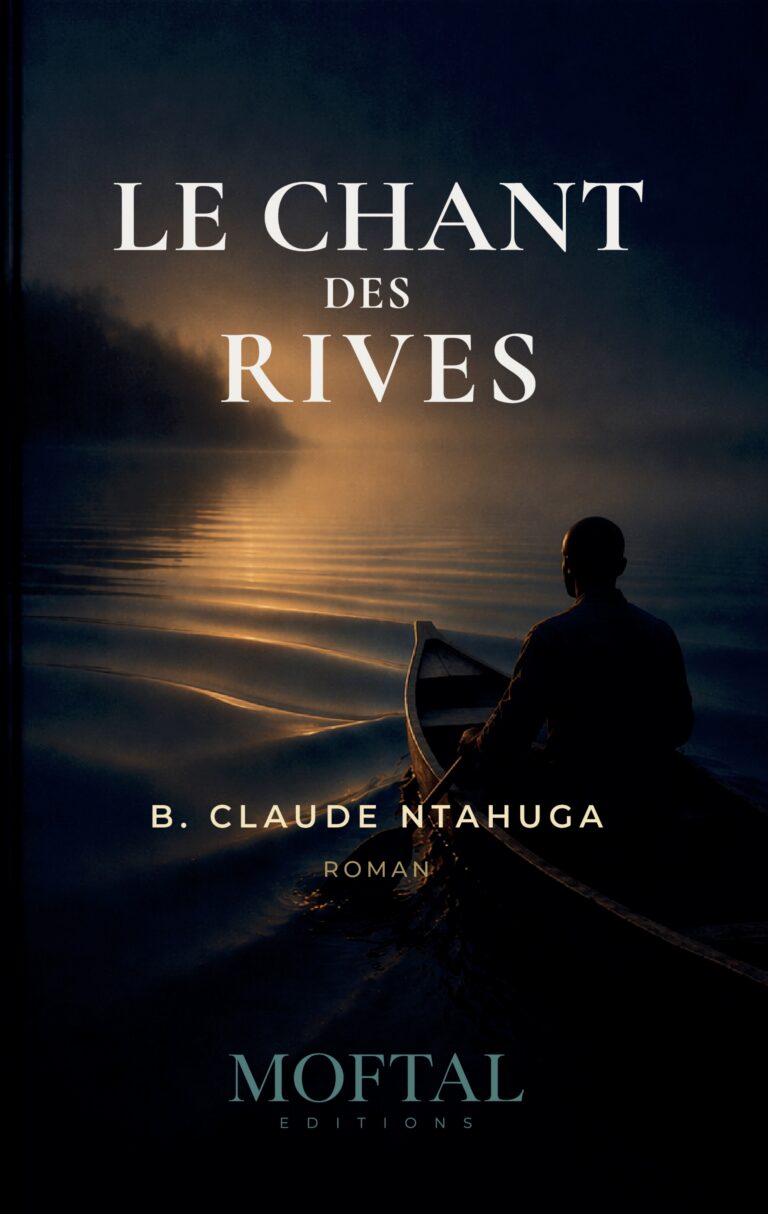
Le chant des rives — Roman
Roman20.00 €
THE BOOK OPENS LIKE THIS
Prologue — Incipit
« Evening was falling gently over Bujumbura, wrapping the city in a veil of mystery. The last rays of the sun reflected on the corrugated iron roofs, casting long shadows across the dusty streets. The air was heavy, saturated with the smell of earth heated by the day and the charcoal embers being lit for the evening meals. Although the bustle was usual, something inexplicable hung in the air, an invisible tension that seemed to make the walls and the hearts vibrate. »
— The Song of the Shores, Prologue
WHAT IT IS ABOUT
Summary
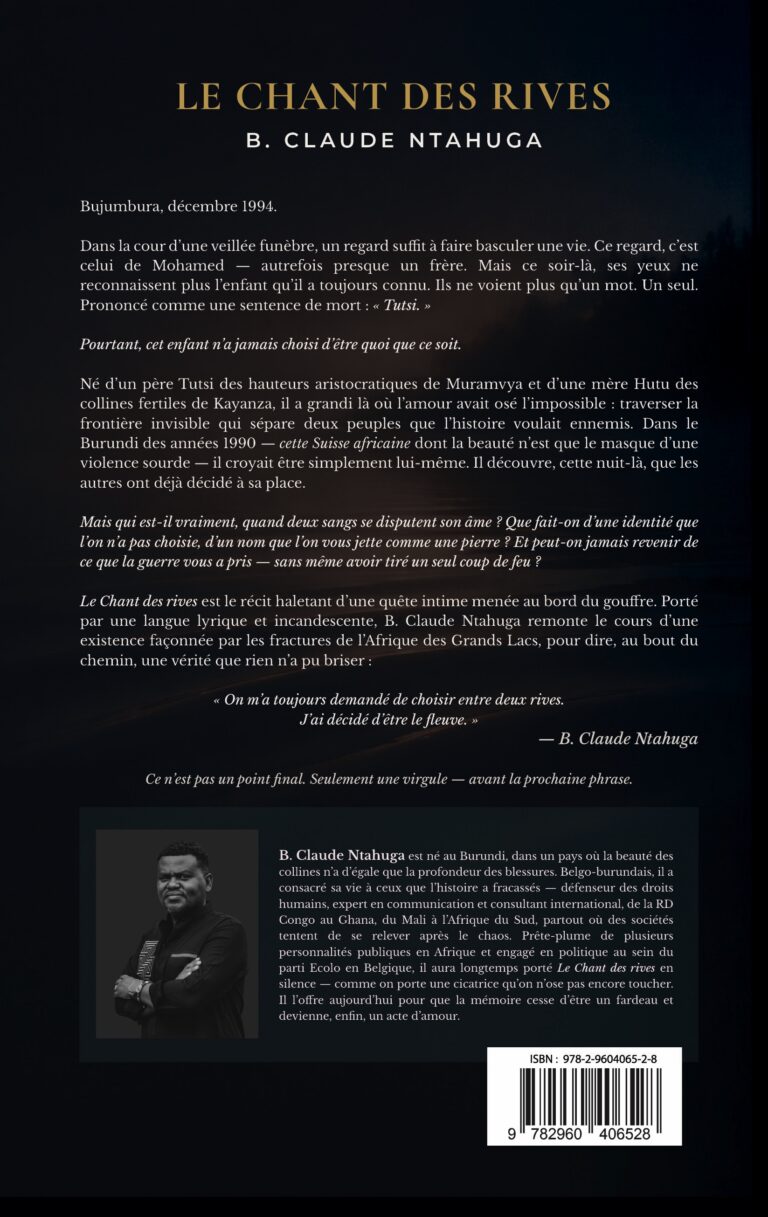
In the heart of 1970s and 1990s Burundi, a child is born of a love that defies every border: a Tutsi father, from the Ganwa aristocracy of Muramvya, and a Hutu mother, survivor of the 1972 massacres. In a society fractured by the invisible lines of ethnicity and memory, their union is an act of courage and defiance.
Through the eyes of the child — turned narrator — unfolds an intimate and historical fresco: the innocence of games in the alleys of Bwiza and Ngagara, the rivalries of a blended sibling group of more than a dozen children, the silent sorrows of an impossible mourning, and the threatening shadow of the 1993 violence that will shatter everything.
This novel is not only the story of a fractured Burundi. It is the story of what love does to borders when it is heard all the way through. It is a universal narrative about the quest for identity, reconciliation with one’s origins, transmission between generations, and the resilience of those who have learned to be the river rather than choose a shore.
BY THE AUTHOR
Author's note
By deciding to write The Song of the Shores, I consented to enter a trunk buried deep in my memory, a travelling chest sealed by decades of silence. I found there fragments of childhood: bursts of laughter cut short too soon, the aroma of my grandmother’s coffee, the red dust that clung to our sandals and our dreams, the heavy gazes of adults who knew but kept silent.
My intention is not to settle scores. I simply want to lay a discreet but solid stone in the wall of silence. A bridge between suffering and hope. A crack so that a ray of light, even flickering, may illuminate the darkest corners of our collective memory.
« To write is to build a bridge. A bridge between the living and the departed, between past generations and those to come, between those who have suffered and those who must understand. »
— B. Claude Ntahuga, Author’s note, 2026
First pages
PREVIEW
CHAPTER 01
Family origins — Muramvya, the ibigabiro, the sacred drums, the intore. The narrator revisits the family tree of a Burundian family woven between tradition and modernity, and the emblematic objects that shaped his childhood.
CHAPTER 03
Marriage and challenges — His parents’ Hutu-Tutsi union at the heart of the social tensions of Muramvya. A pivotal chapter that sheds light on the genesis of a mixed identity in a country forced to choose sides.
CHAPTER 05
The missed holidays — The feeling of being apart, the identity questioning of a child who does not quite find his place on either shore. An intimate text, both tender and lucid.
GO FURTHER
For book clubs & libraries
« When contemporary Africa is lived on two shores: born here, raised there, refusing to choose a single belonging. »
Identity & mixed heritage
/ Novel theme
« 1972, 1993 — how do we speak what official History struggles to recognise? The novel attempts to name without rewriting. »
Memory of violence
/ Novel theme
« To be departing, even when one has stayed. The invisible scars of an uprooting that does not say its name. »
Inner exile
/ Novel theme
« What passes in silence, from elders to the younger: gestures, prayers, fears, prides, and secrets too. »
Family transmission
/ Novel theme
« To love beyond community borders, in a country forced to choose sides — a gesture that comes at a price. »
Love, a political act
/ Novel theme
« How to mend oneself after the unacceptable, and stand without denying the dead. »
Resilience & reconstruction
/ Novel theme
« Between Burundi and Belgium: moving from one world to another, and finding bridges rather than walls. »
Intercultural dialogue
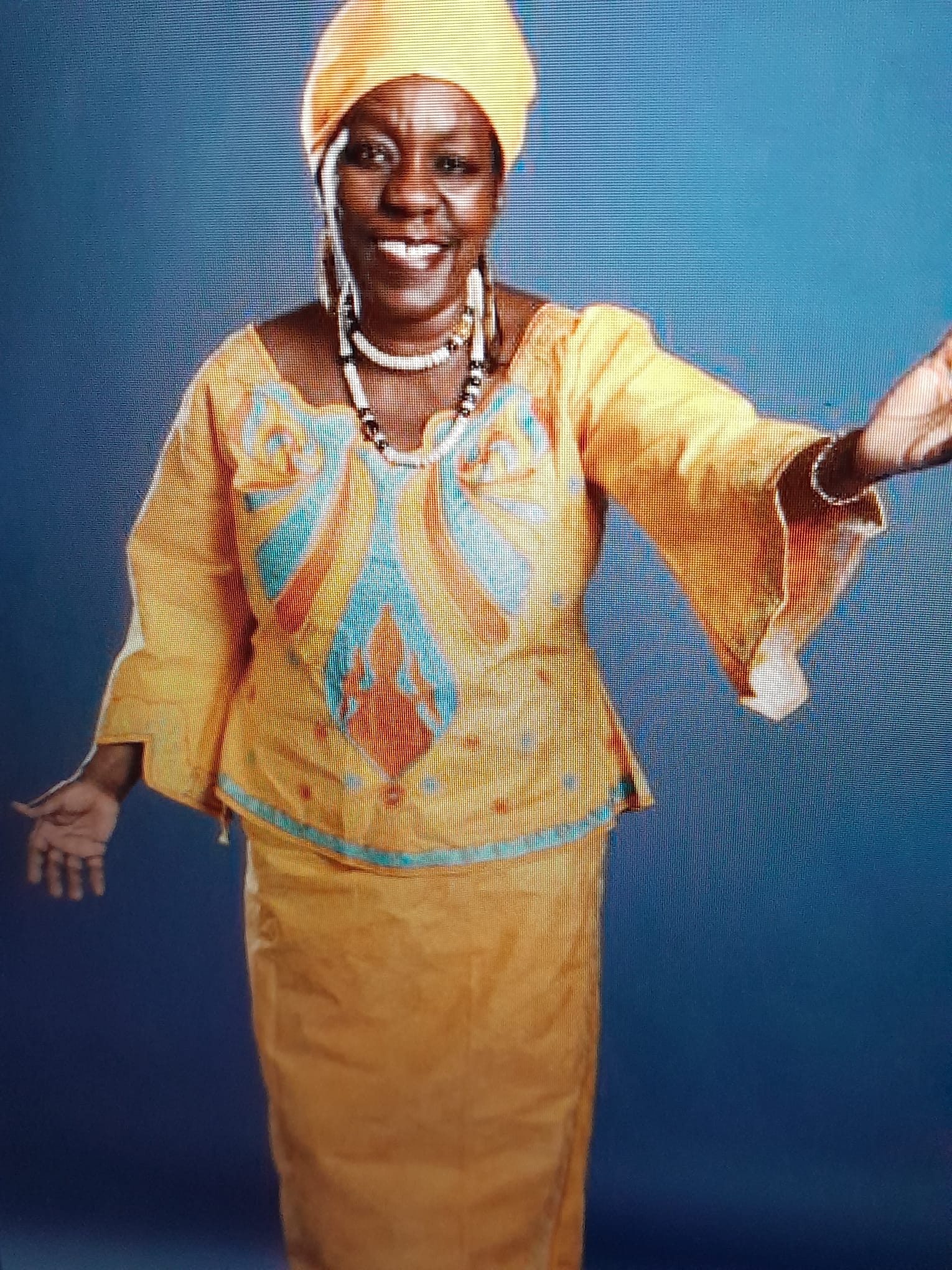
/ Novel theme« I read your manuscript in one sitting. It amused me, moved me deeply, and brought back to life a past that is shared by all of us Burundians, but also unique to each one. »
This book, with all the questions it carries, truly made me discover who you are. And not only you, but also all those who have inhabited your world.
It is with stories like yours that the History of Burundi, on which we struggle to find a consensus, will one day find its foundations. Thank you for your contribution. And happy reading to all those who will give themselves the pleasure of reading you!
Marie-Louise Sibazuri
/ Belgo-Burundian writer, playwright, singer
NEXT NOVEL · UPCOMING
Kidal, breaking point
Between humanitarian work and espionage, in a Mali under tension where alliances change faster than maps, David van Artevelde moves undercover. Sent to Bamako, he observes, listens, negotiates. He learns to disappear. But when a Tuareg journalist with whom he works is executed before his eyes in the North, everything tips.
Convinced he has been betrayed by his own services, David begins to play a double game. Between Bamako and Kidal, between loyalty and treason, the Belgo-Burundian humanitarian must choose who he really is — and whom he can still trust.
Kidal, breaking point is the first volume of an African novel cycle drawn from the author’s direct experience: Mali, Niger, Libya, Chad, South Africa.